Summary

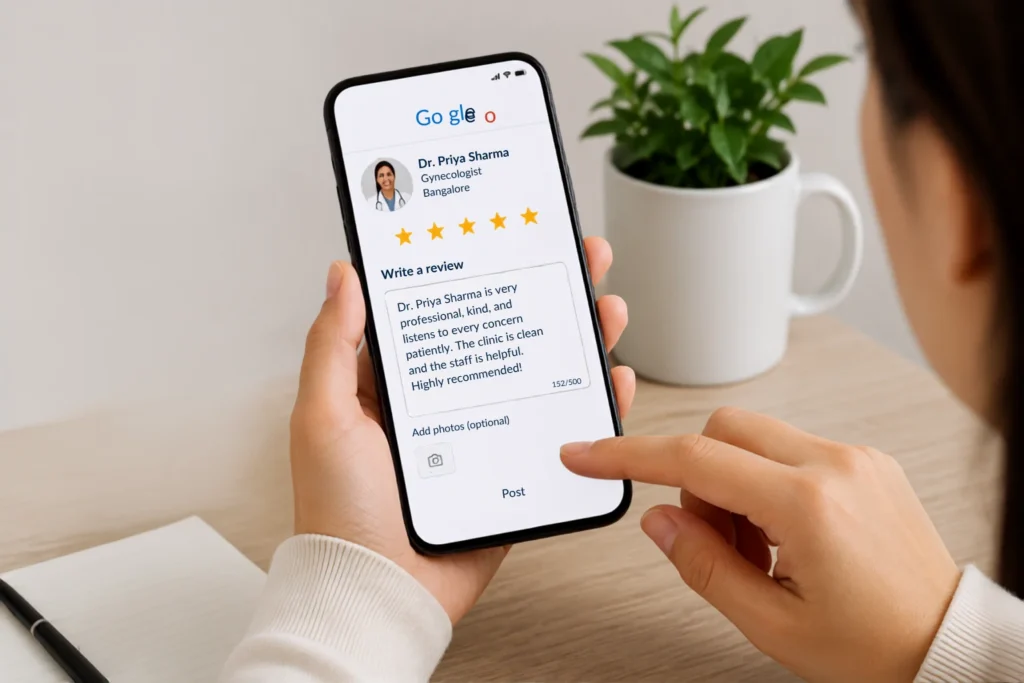
Patient reviews play a big role in how local clinics show up on Google and how patients choose where to go.

This post explains why reviews act as a ranking signal for the local pack and Maps.

It covers how volume, quality, rating, and timing affect visibility.

You will also learn simple ways to collect honest feedback and how to reply to negative comments without risk.

By the end, you will know practical steps any practice can take to improve both search results and patient trust.
Imagine two clinics on the same street.
Both offer the same services, similar hours, and solid care.
One shows up in the Google local pack.
The other barely appears.
What is the difference? Often it comes down to patient reviews.
Yes, patient reviews really matter for local SEO.
They are a primary ranking signal for Google’s local pack and Maps results.
They also drive more clicks and appointments.
This matters even more in healthcare.
Patients make high-stakes choices.
Most research online before they call or book.
In this post, we will look at how patient reviews affect rankings, what makes a review valuable, how to collect more of them, and how to handle negative ones.
Do Patient Reviews Matter For Local SEO?
Yes. Patient reviews are a core local ranking signal.
Google ranks local results mainly on three factors: relevance, distance, and prominence.
Relevance means how well your listing matches the search.
Distance is how close you are to the searcher.
Prominence is how well-known and trusted your practice appears.
Patient reviews feed directly into prominence.
Google has said that high-quality, positive reviews from customers can improve business visibility.
Studies show review signals make up roughly 15 to 20 percent of local pack ranking factors.
Businesses that rank in the top three often have two to three times more reviews than those lower down.
A practice with steady new reviews tends to outrank one with many old reviews and none recent.
How Do Patient Reviews Affect Local SEO?
Patient reviews help in several clear ways.
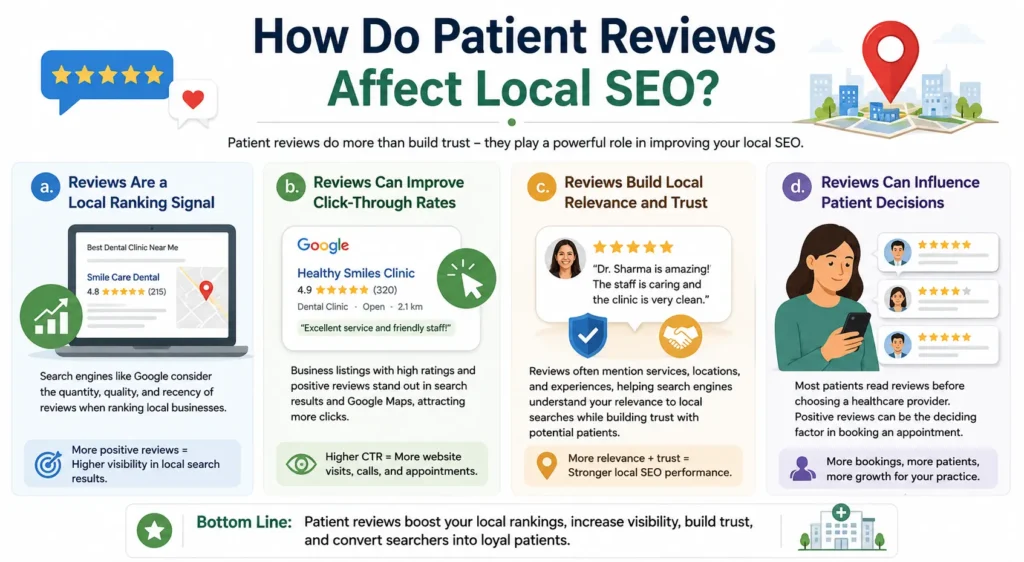
a. Reviews Are a Local Ranking Signal
Google looks at the number of reviews, the average star rating, and how often new ones appear.
Consistent patient reviews signal that your practice is active and trusted.
This can lift your position in the local pack.
b. Reviews Can Improve Click-Through Rates
Star ratings and review counts show right under your listing.
People click more on places that look popular and well-rated.
Higher clicks send a positive signal back to Google.
c. Reviews Build Local Relevance and Trust
When patients write about specific services, locations, or staff, those words can help your listing match more searches.
Trust grows when people see real feedback from others in the area.
d. Reviews Can Influence Patient Decisions
Research shows that about 84 percent of patients check online reviews before choosing a provider.
More than half read at least six reviews.
Around 40 percent have canceled or changed plans because of what they read.
Patient reviews do not just help rankings.
They help convert searches into appointments.
Does Having More Reviews Automatically Mean Better Rankings?
Not automatically.
Quantity helps, but it is not the only factor.
A clinic with 200 reviews and a 4.2 rating may rank higher than one with 30 perfect 5-star reviews.
Google values volume, but also quality, recency, and authenticity.
A practice that stops getting new reviews can lose ground even with a large total.
Steady growth over time usually works better than a sudden burst followed by silence.
Fake or incentivized reviews can also hurt if Google detects them.
What Makes a Patient Review Valuable?
Several elements matter:
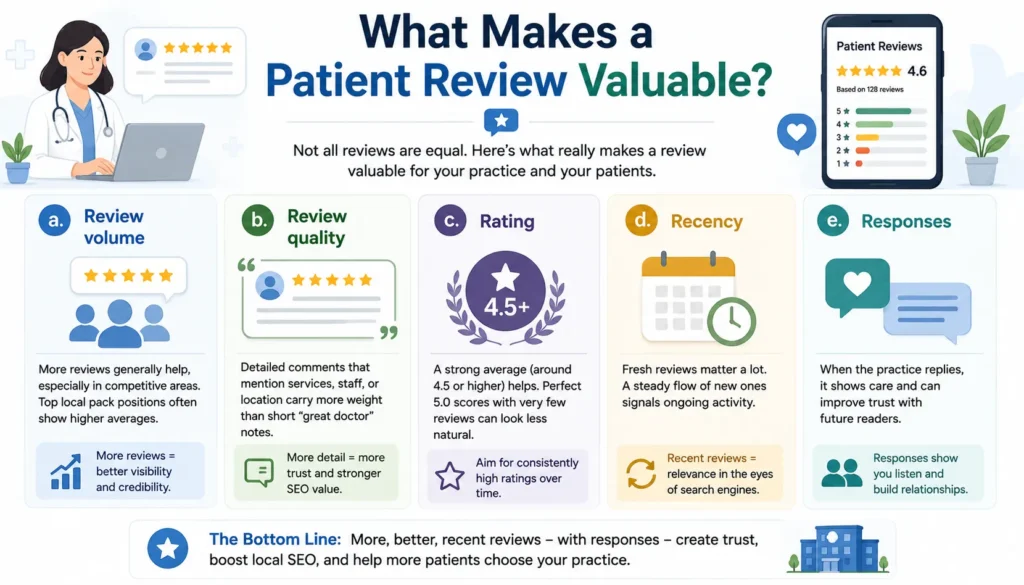
a. Review volume: More reviews generally help, especially in competitive areas. Top local pack positions often show higher averages.
b. Review quality: Detailed comments that mention services, staff, or location carry more weight than short “great doctor” notes.
c. Rating: A strong average (around 4.5 or higher) helps. Perfect 5.0 scores with very few reviews can look less natural.
d. Recency: Fresh reviews matter a lot. A steady flow of new ones signals ongoing activity.
e. Responses: When the practice replies, it shows care and can improve trust with future readers.
Together, these factors make patient reviews more useful for both rankings and patients.
How to Get More Genuine Patient Reviews?
You cannot force reviews, but you can make the process easy and respectful.
Here are practical steps:
– Create a simple review-request process. Decide who asks and when.
– Provide patients with an easy way to find your Google review page. A short link or QR code works well.
– Ask at an appropriate moment. Right after a positive visit or successful treatment is often best.
– Train front-desk staff on how to request feedback professionally. Keep the tone light and optional.
– Send follow-up messages where appropriate and compliant with privacy rules.
– Respond to reviews consistently. Thank people for positive ones and address concerns on negative ones.
– Monitor reviews regularly. Set a weekly check so nothing slips by.
– Use negative feedback to identify operational problems. Fix the root issue when possible.
Keep everything compliant with healthcare privacy rules.
Never pressure patients or offer rewards for reviews.
Genuine patient reviews are the only kind that help long-term.
Should You Respond to Negative Patient Reviews?
Yes. Responding shows you care and can turn a negative into a chance to demonstrate professionalism.
Follow these guidelines:
– Do not become defensive.
– Thank the reviewer for the feedback.
– Keep the response professional and calm.
– Do not reveal private patient information.
– Move the conversation offline when necessary. Offer a phone number or email for further discussion.
– Identify whether the issue is legitimate and requires internal action.
Here is an example of a bad review and a solid response.
Sample negative review:
“Waited over an hour past my appointment time. Staff seemed rushed, and the doctor barely listened. Would not recommend.”
Good response:
“Thank you for sharing your experience. We are sorry the wait and visit did not meet your expectations. We take feedback seriously and are reviewing our scheduling process. Please contact our office manager at [phone or email] so we can learn more and make things right. We value the chance to improve.”
This reply stays professional, avoids private details, and invites offline conversation. Many patients notice how practices handle criticism.
Conclusion
Patient reviews are a high-impact local SEO factor.
They affect both visibility in the local pack and the likelihood that someone books an appointment.
The biggest takeaways are volume, recency, quality, and responses.
Steady, genuine patient reviews over time usually beat a large pile of old ones.
Take a few minutes to audit your current review profile against local competitors.
Then start a simple, consistent process for collecting new ones.
Even small improvements can compound.
If you want help building a review strategy that fits your practice, look for a checklist or talk with someone who works with healthcare local SEO every day.
The practices that treat patient reviews as an ongoing priority tend to see stronger local results over time.
Also Read: Can Social Media Improve Local SEO of a Business?
Frequently Asked Questions
a. Do Google reviews improve local SEO?
Yes. They form part of the prominence signal and help with both rankings and click-through rates.
b. How many reviews does a clinic need to rank on Google?
There is no fixed number. It depends on the competition in your area. Looking at the top three competitors and aiming to match or exceed their volume and recency is a practical approach.
c. Do negative reviews hurt local SEO?
A few negative reviews are normal and rarely destroy rankings if the overall rating stays strong. Ignoring them or responding poorly can hurt more than the review itself.
d. Does responding to Google reviews help SEO?
It can help indirectly. Responses show engagement and improve trust, which may lead to more clicks and stronger signals over time.
e. Can businesses ask patients for Google reviews?
Yes, as long as the request is genuine, optional, and compliant with privacy rules. Never incentivize or pressure patients.
f. Should doctors respond to negative reviews?
Yes, in most cases. A calm, professional reply protects reputation and shows future patients that you listen.
g. Do review keywords improve local rankings?
Natural mentions of services or location in reviews can support relevance. Forced keyword stuffing does not help and can look unnatural.
h. How often should a clinic get new reviews?
Aim for a steady flow rather than long gaps. Even a few genuine reviews each month is better than silence for half a year.

Subham Kakrania is an organic marketer and web developer specializing in custom SEO strategies that drive measurable business growth. From technical audits to high-converting web design, he helps brands scale their organic visibility, outsmart the competition, and turn search traffic into loyal customers.