Key Takeaways:

- Google Reviews build trust, and customers rely on real experiences to judge a local business.
- Ratings influence decisions; star ratings, review volume, and recency can affect purchasing choices.
- Google Reviews support local SEO as they can strengthen local visibility and prominence but don't guarantee rankings.
- Respond to reviews. Professional responses show customers that you value their feedback.
- Handle negative reviews carefully. Stay calm, acknowledge concerns, and avoid public arguments.
- Avoid fake reviews. Genuine feedback builds sustainable credibility and reduces policy risks.
- Make reviewing easy. Direct links, QR codes, and simple follow-ups can encourage more reviews.
- Keep reviews recent, as a consistent flow of fresh feedback is more valuable than relying only on old reviews.
- Maintain your Google Business Profile. Keep your business information accurate, complete, and up to date.
- Make reputation management ongoing. Consistently managing reviews should be part of your local marketing strategy.
Introduction
Picture this.
You search for a bakery near you.
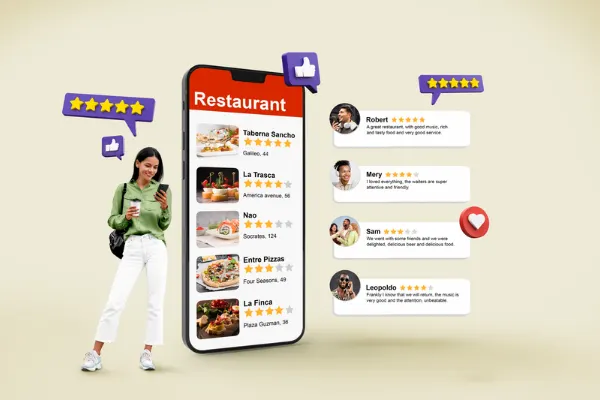
Before you click anything, you see star ratings under every name.
Which one do you tap?
Most of us pick the one with better stars and kind words.
That’s the power of Google Reviews.
They are often the first thing people notice about a local business.
And they do more than build a reputation.
They affect:
- Customer trust
- Clicks and calls
- Local search visibility
- Purchasing decisions
- Business credibility
Here’s the truth.
A business with great products can still lose customers if its online reputation doesn’t inspire confidence.
Let’s see how it all works.
What Are Google Reviews?
Google Reviews are ratings and comments that people leave about a business on Google.
They appear in Google Search and Google Maps, right next to your business details.
Customers leave them through your Google Business Profile.
They find your business, pick a star rating, and add a few words if they like.
A review has a few parts:
- Star rating: a score from one to five.
- Written review: the customer’s story in their own words.
- Review responses: your replies, which anyone can read.
- Photos and videos: real images that show the customer’s experience.
Reviews also appear when someone searches for services nearby, like “plumber near me.”
Your stars can show up before your website does.
Why do they matter so much for local businesses?
Local customers decide fast.
They want a place that is close, trusted, and open now.
Google Reviews help them choose in seconds, often before they visit your website.
How Google Reviews Affect Local Businesses
a. Google Reviews Build Customer Trust
People trust people. A stranger’s honest review often feels more real than an ad.
According to BrightLocal’s 2026 Local Consumer Review Survey, 97% of consumers read reviews for local businesses.
The same survey says 41% of people always read reviews before choosing a business.
That number was 29% the year before.
b. Reviews Influence Buying Decisions
Shoppers look at three things: the rating, the number of reviews, and how recent they are.
The survey found that 47% of consumers won’t use a business with fewer than 20 reviews.
It also found that 74% only care about reviews written in the last three months.
So old reviews won’t carry you forever.
c. Reviews Can Increase Clicks, Calls and Enquiries
Strong stars make people tap your listing.
More taps can mean more calls, direction requests, and website visits.
Photos and real stories make the next step feel easy.
Think about how you search on your phone.
You want an answer fast.
A quick look at stars and a few lines of feedback helps you decide, so a well-reviewed profile often wins the tap.
d. Google Reviews Can Support Local SEO
Reviews give Google more clues about your business.
Customers often mention your services and location in their own words.
We’ll look at the ranking side in a moment.
e. Reviews Improve Your Google Business Profile’s Credibility
A profile with steady reviews and replies looks alive.
A profile with none looks empty.
People may wonder if you’re even open.
f. Positive Reviews Can Give You a Competitive Advantage
Imagine two similar shops on the map.
One has 150 recent reviews and a 4.7 rating.
The other has 12 reviews from two years ago.
Most people will choose the first one.
The Impact of Negative Google Reviews
Nobody loves a bad review.
It can hurt a first impression, especially when the story is angry and the rating is one star.
But one bad review isn’t a disaster.
People look at the whole picture.
A 4.6 rating with a few complaints looks honest.
A perfect score with zero complaints can even look suspicious.
That’s why your overall review profile matters most.
Look at your average rating, your review count, and your recent trend.
How to respond professionally:
- Say thank you for the feedback.
- Stay calm and polite, even if it feels unfair.
- Apologize where it makes sense.
- Offer to fix the problem offline.
- Keep it short and don’t argue in public.
A good reply also speaks to future customers.
Many people read how a business handles complaints.
A calm, helpful answer can turn a bad review into proof that you care.
Not all negative reviews are the same:
- Genuine negative feedback: a real customer with a real problem. Reply and learn from it.
- Fake reviews: written by people who never used your service. Report them.
- Spam: ads, links, or random nonsense. Flag it.
- Policy violations: reviews with threats, hate, or off-topic content may break Google’s rules. Ask for removal.
Here’s the key point.
Ignoring negative reviews can sometimes be worse than getting them.
Silence tells customers you don’t care.
Do Google Reviews Directly Improve Your Ranking?
They help, but they aren’t magic.
Google uses many signals to decide which local businesses to show.
Reviews can add to your prominence, which is how well known and trusted you are.
Google says on its own help pages that review count and score can affect local ranking.
So reviews matter, but they work together with other signals.
Still, hundreds of Google Reviews don’t guarantee the top spot.
A business with fewer reviews can beat you if its other signals are stronger.
Local SEO also depends on:
- Relevance: how well your profile matches the search.
- Distance: how close you are to the searcher.
- Business information: correct name, address, phone, and hours.
- Website: clear, helpful pages.
- Citations: your business listed correctly on other sites.
- Links: other websites pointing to yours.
- Prominence: how well known your business is.
- User engagement: clicks, calls, and direction requests.
So don’t believe the claim that more reviews always means a higher ranking.
Think of reviews as one strong piece of a bigger puzzle.
How to Get More Google Reviews?
a. Ask Customers at the Right Time
Ask when people are happiest.
That could be right after a job is done, a meal is finished, or a problem is solved.
b. Make Reviewing Easy
Share your direct review link in a text, an email, or a QR code on your counter.
Fewer steps mean more reviews.
Many happy customers never leave a review simply because no one asked.
A small nudge goes a long way.
c. Train Your Team to Ask
Teach your staff to ask in a friendly way.
Something simple works: If you enjoyed your visit, we’d love a quick review.
d. Follow Up With Customers
Send one polite reminder a day or two later.
Say thank you either way. Don’t send ten messages.
e. Never Buy Fake Reviews
It breaks Google’s rules, and fake reviews can be removed.
Customers can often spot them too. Honest reviews take longer, but they last.
Common Google Review Mistakes Local Businesses Make
- Not asking customers for reviews
- Having an outdated Google Business Profile
- Ignoring reviews
- Responding emotionally to negative reviews
- Buying fake reviews
- Asking only happy customers in a manipulative way
- Getting lots of reviews in a very short time
- Never replying to positive reviews
- Treating reviews as separate from your local SEO plan
Profile care is a big one.
BrightLocal research found that only 35% of small businesses have a Google Business Profile.
Claiming yours and keeping it fresh gives you a real edge.
Most of these mistakes come down to one thing.
Reviews need steady attention, not a one-time push.
A sudden flood of reviews can also look odd, so aim for a natural flow.
Also Read: Local SEO Mistakes That Can Make Your Business Invisible
Conclusion
Google Reviews aren’t just ratings on a search result.
They are part of your digital reputation, and they shape how customers find, judge, and choose your business.
The takeaway is simple.
Deliver a great customer experience, ask for honest feedback often, reply with care, and treat reviews as an ongoing part of your local marketing.
Frequently Asked Questions
a. Do Google Reviews affect local SEO?
Yes. Reviews support your prominence and give Google more context. They work best with accurate business details and a good website.
b. How do Google Reviews affect customer decisions?
People use them as a quick trust check. Rating, review count, and recent feedback all play a part.
c. Do more Google Reviews improve rankings?
They can help, but they’re not the only factor. Relevance, distance, and business details matter too.
d. How many Google Reviews should a business have?
There’s no magic number. A good goal is to beat nearby competitors and keep adding fresh ones. Many shoppers want at least 20
e. Is a 5-star rating enough for local SEO?
No. A high rating helps, but ranking depends on many signals. A rating slightly below five also feels more believable.
f. Can negative Google Reviews hurt a business?
They can, mainly if they pile up or go unanswered. A few bad ones with polite replies usually do little harm.
g. Should a business respond to every Google Review?
Try to. Thank people for good reviews and answer bad ones calmly. It shows you care.

Subham Kakrania is an organic marketer and web developer specializing in custom SEO strategies that drive measurable business growth. From technical audits to high-converting web design, he helps brands scale their organic visibility, outsmart the competition, and turn search traffic into loyal customers.