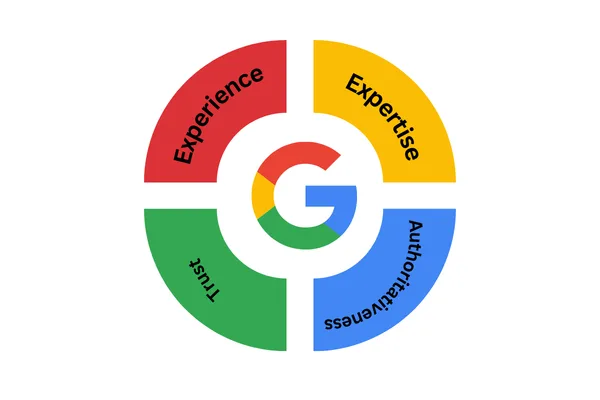
No. Google has confirmed that E-E-A-T is not a direct ranking factor. There is no single "E-E-A-T score" that Google calculates. Instead, E-E-A-T is a framework used by Google's human quality raters to evaluate content quality. Google's ranking systems are then designed to reward content that shows these same qualities. So while it does not directly move rankings, it shapes what Google's algorithm is built to find and reward.
What Is E-E-A-T?
E-E-A-T comes from Google’s Search Quality Rater Guidelines, a document Google uses to train human reviewers.
These reviewers do not directly change rankings. But their feedback helps Google understand if its algorithm is doing a good job.
The acronym stands for four things:
a. Experience
Previously, there was only the E-A-T framework; experience is a new addition here.
Google wants to know if the person who created the content has real, first-hand experience with the topic.
For example, a product review written by someone who actually used the product carries more weight than one written by someone who just researched it online.
b. Expertise
Does the person writing the content actually know what they are talking about? Expertise can be formal, like a doctor writing about medicine.
But it can also be informal, like a lifelong gardener sharing tips about growing tomatoes.
c. Authoritativeness
This is about your reputation in your space. Are other trusted websites talking about you? Are you known as a reliable source in your industry?
Authority is often built over time, not overnight.
d. Trustworthiness
This is the most important piece of the four, according to Google.
Trust covers everything from your site’s security (HTTPS) to how transparent you are about who you are and where your information comes from.
Is E-E-A-T a Direct Google Ranking Factor?
No, E-E-A-T is not a direct Google Ranking Factor!
Google’s Search Liaison, Danny Sullivan, has clearly said that E-E-A-T is not something Google directly measures or scores.
No algorithm gives your page an “E-E-A-T score” of 7 out of 10.
Here is how Google puts it in their own guidelines: E-E-A-T is used as a way to think about content quality, not as a formula plugged into their systems.
So why do so many SEOs treat it like a ranking factor?
Because the qualities that make up E-E-A-T- things like trustworthy content, real expertise, and strong reputation- are exactly what Google’s algorithm is designed to look for and reward.
It is more like a guiding philosophy than a checkbox.
If E-E-A-T Isn’t a Ranking Factor, Why Does It Matter?
Even though E-E-A-T is not a ranking factor, it remains highly relevant and still matters.
Think of it this way. Google’s goal is to show users the most helpful, reliable, and accurate content possible.
E-E-A-T describes what that content looks like.
So when you build content that checks those boxes, you are essentially building content that Google’s systems want to rank.
Reasons:
a. Helpful content wins. Since Google’s Helpful Content Update, content written for people, not just search engines, performs better. E-E-A-T sits at the heart of that philosophy.
b. Reputation matters. A 2023 study by Semrush found that websites with strong brand recognition and backlink profiles consistently outperformed lesser-known sites, even with similar content quality.
c. User satisfaction is key. If users trust your content and find it useful, they stay longer, share it more, and come back again. These signals feed into how Google perceives your site over time.
d. Credibility builds rankings indirectly. When authoritative sites link to you, and people mention your brand online, it sends trust signals to Google. That is E-E-A-T at work.
e. Content quality signals are real. Google uses hundreds of signals to assess quality. Many of them, like how well a page covers a topic or whether an author is cited elsewhere, align directly with E-E-A-T principles.
How Google Evaluates E-E-A-T?
Even though there is no direct score, Google does look at several things to determine if your content meets its quality standards. Here is how it breaks down:
a. Content Quality
– Accuracy: Is the information correct and up to date?
– Depth: Does the content actually answer the question fully, or does it skim the surface?
– Original insights: Does it offer something unique, like a personal experience, a case study, or fresh data?
Thin content or content that just repeats what everyone else says is unlikely to perform well.
b. Website Reputation
– Brand mentions: Are people talking about your brand on reputable websites?
– Reviews: Do you have genuine customer reviews on platforms like Google or Trustpilot?
– Industry recognition: Have you been featured in news articles, industry blogs, or professional organizations?
Google’s quality raters are actually told to look up a website’s reputation outside of the website itself. So what others say about you matters just as much as what you say about yourself.
c. Author Information
– Author bios: Does your content show who wrote it?
– Credentials: Do authors have qualifications or experience relevant to the topic?
– Track record: Has the author published other trusted content in the same space?
A byline from a named expert with a clear bio builds far more trust than “Staff Writer.”
d. Trust Signals
– HTTPS: Your site must be secure. This is non-negotiable.
– Contact information: Make it easy for users to reach you.
– Editorial policies: Show that your content goes through a review process.
– Citations: Link to reputable sources. Back up your claims with data.
A study by Backlinko found that pages with more external links to authoritative sources tend to rank higher. Citing your sources is not just good practice; it is good SEO.
Conclusion
So, is E-E-A-T a ranking factor? No, not in the traditional sense.
There is no dial that Google turns up or down based on your E-E-A-T level.
But here is the real takeaway:
E-E-A-T describes exactly the kind of content Google is always trying to surface.
When you focus on being genuinely helpful, transparent, credible, and experienced in your space, you are playing the long game, and that is the game worth playing.
Do not try to “optimize for E-E-A-T” like it is a technical checklist.
Instead, focus on building real expertise, earning trust, and putting out content that actually helps people.
That is what works. And that is what Google rewards.
Remember, E-E-A-T is not something you “add” to a website overnight. It is built through consistent expertise, transparent business practices, and genuinely helpful content over time.
If you’d like help identifying E-E-A-T gaps on your website and creating a content strategy that builds trust with both users and search engines, take a look at our SEO services to see how we can help.
Frequently Asked Questions
1. Why is E-E-A-T important for Google?
Google’s job is to show people the most helpful and reliable information possible. E-E-A-T helps Google figure out which content actually does that. When a page shows real experience, solid expertise, and a trustworthy reputation, Google sees it as worth showing to users. Simply put, E-E-A-T helps Google separate genuinely good content from content that just looks good on the surface.
2. What are Google’s E-E-A-T standards?
Google does not publish a fixed list of rules, but based on its Search Quality Rater Guidelines, here is what it looks for:
– Content written by someone with real knowledge or hands-on experience
– Clear author information, including bios and credentials
– Accurate, well-researched, and up-to-date information
– A website with a strong reputation backed by third-party mentions and reviews
– Proper trust signals like HTTPS, contact pages, and editorial transparency
– Citations and links to credible, authoritative sources
These are not checkboxes with scores attached. They are qualities that Google’s systems are trained to recognize and reward over time.
3. What is the difference between “E-A-T” and “E-E-A-T”?
EAT stands for Expertise, Authoritativeness, and Trustworthiness. Google introduced it in its Search Quality Rater Guidelines back in 2014. In December 2022, Google added an extra “E” for Experience, making it E-E-A-T.
The key difference is that extra layer of first-hand experience. Under the old EAT model, being an expert was enough.
Under E-E-A-T, Google also wants to know if you have actually done the thing you are writing about. For example, a travel blogger who has personally visited a destination carries more weight than someone who just compiled information from other articles.
4. Is there an E-E-A-T score?
E-E-A-T is a framework, not a formula. So there is no E-E-A-T score. Google does not assign a number or grade to your content or website based on E-E-A-T. You will not find it in Google Search Console, and no third-party SEO tool can measure it accurately either.
5. Can AI-generated content meet E-E-A-T?
Yes, but with conditions. Google has said it does not automatically penalize AI-generated content. What matters is whether the content is helpful, accurate, and trustworthy, regardless of how it was produced.
That said, AI content often struggles with the “Experience” part of E-E-A-T. AI tools cannot visit a place, test a product, or share a real personal story. So content that relies entirely on AI, without any human review, real-world experience, or expert input, usually falls short.
6. Is E-E-A-T important for every website?
Yes, but the level of importance varies depending on your topic. E-E-A-T matters for all websites, but it is absolutely critical for what Google calls YMYL topics. YMYL stands for “Your Money or Your Life” and covers areas like:
– Health and medical advice
– Financial planning and investment
– Legal information
– Safety and emergency guidance
For these topics, low-quality or untrustworthy content can cause real harm to real people. So Google holds them to a much higher standard. If your site covers any of these areas, building strong E-E-A-T is not optional. It is essential.
7. How long does it take to build E-E-A-T?
There is no fixed timeline. Building authority and trust takes consistent effort over months or even years. Publishing quality content regularly, earning mentions, and growing your reputation all add up gradually.

Subham Kakrania is an organic marketer and web developer specializing in custom SEO strategies that drive measurable business growth. From technical audits to high-converting web design, he helps brands scale their organic visibility, outsmart the competition, and turn search traffic into loyal customers.